

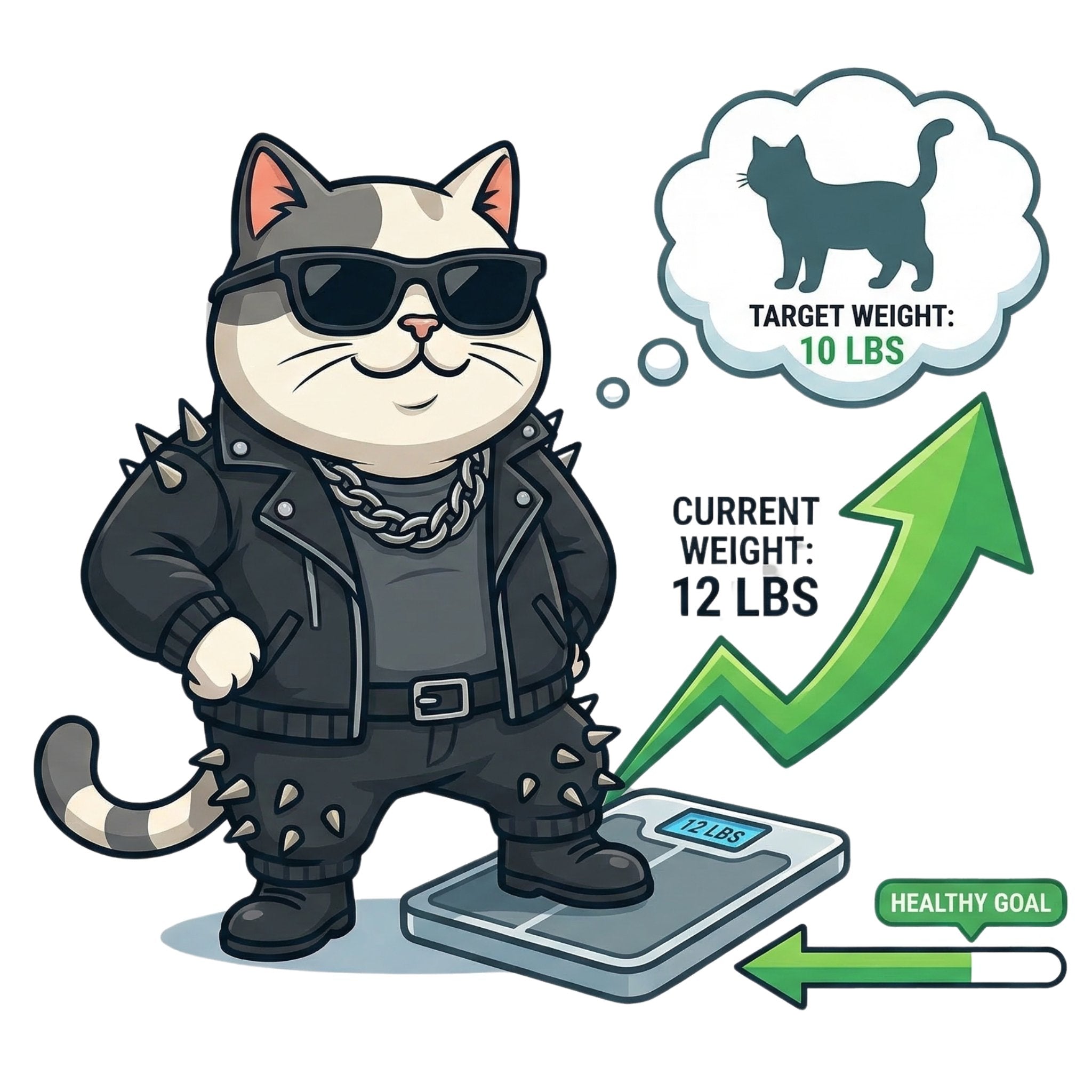

🐾 Looking for a fast answer? Start with the Cat Weight Calculator, then use this guide to understand what the result actually means.
If you also want feeding guidance, open the Cat Calorie Calculator. If you want age and life-stage context, check the Cat Age Calculator.
If you searched for how much should my cat weigh, healthy cat weight, average cat weight by breed, is my cat overweight, is my cat underweight, or healthy cat weight by age and breed, this guide is built to give you a better answer than one random number on a chart.
A healthy cat weight depends on breed, age, sex, body frame, body condition score, muscle condition, activity level, and weight trend over time. That is exactly why the Cat Weight Calculator is more useful than a one-size-fits-all average. Two cats can both be healthy while sitting at very different numbers on the scale.
This guide helps you go beyond the number. You will learn what healthy cat weight really means, how to judge body shape more accurately, why breed matters, how kittens and senior cats should be interpreted differently, when weight change becomes a concern, and what practical next step makes sense after checking the result.
🔎 Quick jump
What is a healthy cat weight? · Why breed, age, and sex matter · How to assess body condition · Signs of underweight and overweight cats · Common cat weight myths · What to do after using the calculator · FAQs · Sources

⚖️ What is a healthy cat weight?
A healthy cat weight is not one universal number. It is a practical range that makes sense for that specific cat. A large, dense, heavy-framed cat should not be judged by the same baseline as a smaller, finer-framed cat. That is why a good cat weight calculator by breed should never treat every cat the same.
In real life, the strongest answer to how much should a cat weigh is usually a range, not one rigid target. Cats differ in genetics, build, muscle, coat, activity, and life stage. A realistic range is more useful for everyday care, easier to compare with repeat weigh-ins, and much better for long-term monitoring than one fixed number.
That is also why owners often get confused by generic charts. A fluffy cat may look bigger than it really is. A naturally athletic cat may look light without being unhealthy. A senior cat may keep a similar number on the scale while slowly losing lean muscle. The scale matters, but context matters more.
- 🐈 Breed changes the baseline
- 🧬 Body frame and muscle change the interpretation
- 👶 Kittens should be judged for growth, not adult targets
- 🧓 Senior cats need closer attention to muscle loss and trend
- 📈 Repeat weigh-ins matter more than one isolated number
If you want a quick answer first, open the Cat Weight Calculator. If you want the deeper explanation behind the number, keep reading.
🧬 Why breed, age, and sex matter in a cat weight calculator
A better cat weight calculator by breed gives a much stronger starting point than a generic “average cat weight” article. Some breeds are naturally bigger, denser, and slower to mature. Others are naturally lighter, leaner, and more refined in build. That difference is normal.
For example, larger breeds such as Maine Coon, Ragdoll, and Norwegian Forest Cat often sit much higher on the scale than lighter or smaller-framed breeds such as Oriental Shorthair, Japanese Bobtail, Turkish Angora, or Munchkin. That does not automatically make the larger cat overweight or the smaller cat underweight. It means the number must be read in context.
🐱 Adult cat weight
Adults usually give the clearest interpretation because growth is complete and the breed profile is easier to judge. If you are checking an adult cat, a breed-aware estimate is far more useful than a random average that ignores body type.
🐾 Kitten weight
Kittens should not be judged like adults. In kittens, the real priority is steady growth, good appetite, normal stool quality, hydration, body condition, and repeat weigh-ins. A healthy kitten does not need to match an adult-style target too early. Growth is the goal, not premature comparison.
🧓 Senior cat weight
Senior cats need more nuance. An older cat can look stable on the scale and still lose lean muscle over time. In seniors, weight should always be interpreted together with muscle condition, appetite, grooming, mobility, coat quality, and long-term trend. In older cats, the question is not only “what do they weigh?” but also “what are they made of?”
⚥ Male vs female cat weight
Male cats often sit a little higher within a breed range, while females may sit a little lower, but the difference is usually modest. Sex helps refine the estimate, but it does not replace breed, body condition, frame size, or long-term monitoring.
📌 Practical takeaway: breed provides the baseline, age changes how you interpret it, and sex can fine-tune the target slightly. Healthy cat weight is never just one number copied from a chart.
👀 Why the scale alone is not enough: body condition score and muscle condition
One of the biggest mistakes owners make is treating the scale as the full story. A number can help, but it does not tell you everything. Two cats can weigh the same and still have very different body composition. One may be lean and muscular. The other may carry more body fat and less muscle.
That is why veterinarians use Body Condition Score (BCS) and often also think about Muscle Condition Score (MCS). In simple terms, BCS helps answer whether the cat is carrying too little, appropriate, or too much body fat. MCS helps answer whether the cat is preserving lean muscle well.
For many cats, an ideal body condition is around 5/9 on the 9-point scale, or roughly 3/5 on the 5-point scale, though individual context still matters. That is one reason a useful weight check always combines the scale with visual assessment, hands-on palpation, and the trend over time.
⬆️ What to look for from above
- A healthy-weight cat usually has a visible waist behind the ribs.
- An overweight cat often looks broader through the middle, with a less obvious waist.
- An underweight cat may look too narrow, especially through the waist and hips.
➡️ What to look for from the side
- A healthy cat usually has some abdominal tuck.
- An overweight cat may look rounder underneath, with less tuck and more abdominal fat.
- An underweight cat may show a sharper tuck with more visible bony landmarks.
✋ What to feel with your hands
- You should be able to feel the ribs under a light fat covering.
- If ribs, spine, and hips are very obvious with minimal fat cover, the cat may be below a healthy range.
- If ribs are hard to feel and the cat has a rounder outline or abdominal fat pad, the cat may be above a healthy range.
💡 Practical rule: weigh the cat, assess body condition, think about muscle tone, and compare the result with the trend over time.
That gives a much stronger answer than the scale alone.

📉📈 How to tell if a cat may be underweight or overweight
Owners often notice body shape changes before they notice the number on the scale. That can be helpful, but appearance should support the calculator result, not replace it. Some cats look larger because of coat. Some look leaner because of build. Some heavier-framed breeds are naturally substantial. The best reading combines shape, body condition, and repeated weigh-ins.
🔻 Signs your cat may be below a healthy range
- Unplanned weight loss
- More visible ribs, spine, hips, or pelvic bones
- Reduced muscle over the back, hips, or thighs
- Lower appetite or reduced interest in food
- Digestive upset, repeated vomiting, or diarrhea
- A downward trend across repeated weigh-ins
🔺 Signs your cat may be above a healthy range
- Less visible waist when viewed from above
- Rounder shape through the middle
- Ribs becoming harder to feel
- A growing abdominal fat pad
- Lower activity or reduced stamina
- Difficulty grooming, jumping, or moving comfortably
- A steady upward trend on repeat weigh-ins
If your cat appears to be drifting outside a practical range, do not panic over one reading. Look for patterns. The Cat Weight Calculator helps interpret the current number. The Cat Calorie Calculator helps turn that result into a practical feeding direction.
🧠 Common myths about cat weight
Myth 1: There is one normal weight for every cat
False. Breed, frame, age, muscle, and body condition all change the interpretation.
Myth 2: A fluffy cat is automatically a heavy cat
False. Coat can make a cat look much bulkier than it really is. That is why hands-on body condition assessment matters.
Myth 3: If the number is “average,” the cat is healthy
False. A cat can sit near a typical number and still be losing muscle, gaining fat, or drifting in the wrong direction.
Myth 4: Fast weight loss is better if a cat is overweight
False. In cats, overly rapid weight loss can be dangerous. Slow, controlled progress matters far more than aggressive restriction.
Myth 5: Kittens should be judged by adult standards
False. Kittens should be assessed for steady growth and condition, not pushed into adult expectations too early.
🧭 What to do after using the cat weight calculator
Once you have checked the result, the next question is not just “Is this number good or bad?” It is “What direction makes sense now?”
✅ If your cat is within the expected range
The goal is usually maintenance. Keep feeding consistent portions, monitor body shape, and repeat weigh-ins regularly. The Cat Calorie Calculator can help estimate daily calories for stable maintenance.
⬇️ If your cat appears below range
Look at the trend. Has the cat always been small and fine-framed, or is this a new drop? Review appetite, stool quality, vomiting, energy, and muscle tone. If the loss is unplanned, progressive, or unexplained, veterinary input matters.
⬆️ If your cat appears above range
The goal is usually controlled reduction, not extreme restriction. Portion accuracy, calorie awareness, repeat weigh-ins, and consistency matter much more than dramatic changes that fall apart after a week.
🐾 If your cat is a kitten
Think growth, not dieting. The focus should be steady development, appropriate intake, and monitoring. Use the calculator as context, not as a reason to force adult-style weight expectations.
🧓 If your cat is a senior
Look beyond the number. Check appetite, hydration, mobility, coat quality, grooming, muscle tone, and how the cat is functioning day to day.
🔥 Best next step after checking weight:
Use the Cat Calorie Calculator to turn your result into a daily feeding direction for maintenance, gradual gain, or controlled weight loss.
⏱️ How often should you weigh a cat?
If you are monitoring a healthy adult cat at home, regular check-ins can help you catch slow drift early. If the cat is on a weight plan, closer follow-up makes more sense. The goal is not to obsess over tiny daily variation. It is to see the direction clearly enough to act before a small issue becomes a larger one.
For the most useful home tracking:
- Use the same scale whenever possible.
- Weigh at a similar time of day.
- Record the number instead of relying on memory.
- Compare the trend, not one isolated reading.
- Take note of appetite, activity, and visible body shape at the same time.

🐟 Safe cat weight loss: why slow progress matters
If your cat is overweight, safe progress matters more than fast progress. In cats, aggressive dieting can backfire. Rapid weight loss may increase risk instead of improving health. The best approach is structured, measured, and monitored.
That usually means:
- Using a clear calorie target
- Measuring food accurately
- Reducing hidden extra calories from treats or free-feeding
- Tracking the weight trend over time
- Adjusting based on progress instead of guessing
A kitchen gram scale is often far more accurate than eyeballing portions or relying on cups alone. If the cat is substantially overweight, older, unwell, or has any medical history, veterinary guidance is the safest way to structure the plan.
Want the practical next step? Open the Cat Calorie Calculator and turn the weight result into a feeding direction for maintenance, gradual gain, or controlled weight loss.
🕒 How cat age changes weight interpretation
Weight questions make more sense when you connect them to life stage. A growing kitten, a healthy adult, and a senior cat do not need the same interpretation. That is why age can strengthen the weight result instead of leaving you with a number that feels disconnected from real life.
If you are not fully sure how age changes the reading, open the Cat Age Calculator. It helps place the cat into a more useful life-stage context, which is especially helpful when you are deciding whether the result should be read as growth, adult maintenance, or senior monitoring.
🧰 Related cat tools
- Cat Weight Calculator – check whether your cat appears below range, within range, or above range
- Cat Calorie Calculator – estimate daily calories for maintenance, gain, or controlled weight loss
- Cat Age Calculator – understand life stage and age context
- Cat Cost Calculator – estimate monthly, annual, and lifetime cat ownership costs
- Cat Name Generator – find cat names by vibe, style, and theme
❓ Cat weight calculator FAQs
What is a healthy weight for a cat?
There is no single healthy number for every cat. Breed, age, sex, frame, body condition, muscle condition, and long-term weight trend all matter. That is why a breed-aware cat weight calculator is more useful than one generic average.
How much should an adult cat weigh?
That depends on breed and body type. A healthy adult cat weight should usually be interpreted as a practical range, not one universal number for every cat.
Do male cats weigh more than female cats?
Often a little, yes, but usually not enough to override breed and body condition. Sex helps refine the estimate rather than define it by itself.
Is this cat weight calculator exact?
No. It is a practical estimate and planning tool, not a diagnosis. It works best when used together with body condition, muscle condition, and repeated weigh-ins over time.
How do I know if my cat is overweight?
Look for a less visible waist, a broader middle, ribs that are harder to feel, a larger abdominal fat pad, and a steady upward weight trend. Use the calculator result together with what you see and feel.
How do I know if my cat is underweight?
Look for visible ribs, spine, hips, muscle loss, a sharper tuck, and unplanned weight loss over time. If appetite is poor or the loss is unexplained, speak with a veterinarian.
What should I do after checking my cat’s weight?
The best next step is usually feeding guidance and monitoring. Open the Cat Calorie Calculator to turn the result into a more practical daily direction.
Can I judge my cat’s health by weight alone?
No. Weight is useful, but it should be read together with body condition score, muscle condition, appetite, energy, grooming, mobility, and the long-term trend.
🏁 Final takeaway
A better answer to how much should my cat weigh is not one random number. It is a more complete interpretation: the scale reading, the breed context, the age and sex setting, the body condition, the muscle condition, and the direction of change over time.
That is exactly what makes a practical Cat Weight Calculator valuable. It gives you a stronger starting point. Then the Cat Calorie Calculator helps turn that result into action, while the Cat Age Calculator adds life-stage context when you need it.
If your cat is losing weight without explanation, gaining unusually fast, eating poorly, vomiting often, having ongoing diarrhea, or losing muscle even when the number looks similar, veterinary assessment matters more than any online tool.


