

Cat Cost Calculator

Cat Cost Calculator
Build a practical cat care budget across four countries
Choose the USA, UK, Canada, or Australia, set whether you are planning for a new cat or one you already own, then compare recurring care, a safer set-aside, the next 12 months, and the longer-term estimate.
How This Cat Cost Calculator Works
This cat cost calculator is built to give cat owners a planning estimate that feels more realistic than a single average number. Instead of collapsing everything into one generic monthly figure, it separates recurring care, reserve planning, one-time startup costs, first-year expenses, and long-range ownership cost so the result is easier to read and more useful in real life.
The calculator starts with the core profile of the cat and household. Country, life stage, lifestyle, number of cats, food quality, litter type, insurance level, grooming needs, travel-related care, and enrichment level all influence the estimate. Those inputs shape the model before any custom cost overrides are applied.
Turn cat ownership into a practical budgeting framework instead of a vague guess, while still letting the user replace defaults with real numbers.
What goes into the estimate?
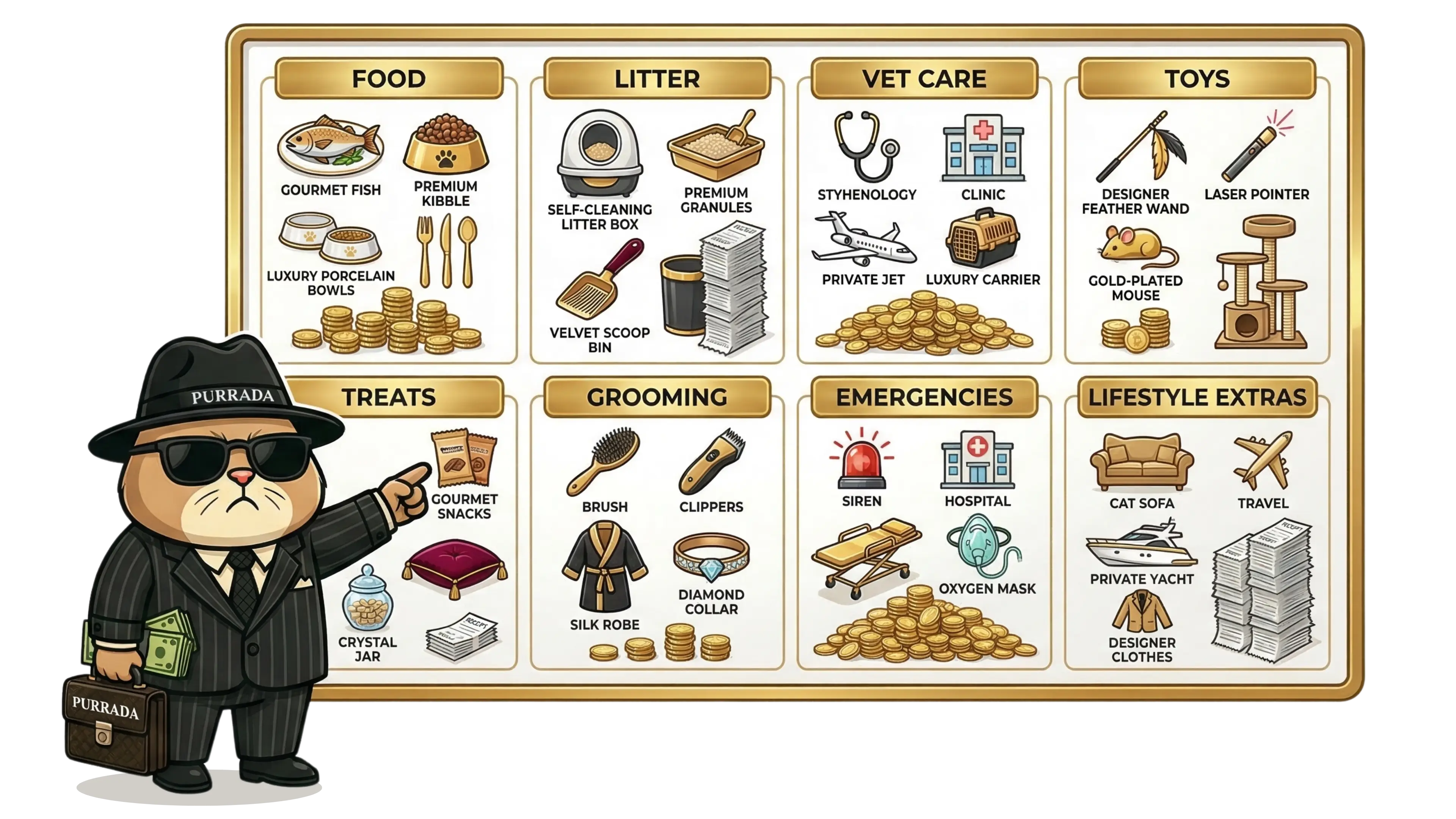
The calculator divides cat cost into separate cost families. That matters because food, litter, routine veterinary care, prevention, insurance, enrichment, grooming, toys, accessories, travel care, one-time entry costs, and reserve planning do not behave in the same way. Keeping them separate creates a clearer picture.
📅 Recurring categories
- Food
- Litter
- Routine vet care
- Prevention
- Insurance
- Treats and toys
- Grooming
- Travel care
- Enrichment
- Replacement accessories
🍼 One-time and long-range categories
- Adoption or breeder cost
- Vaccinations
- Microchip
- Spay or neuter
- Initial setup supplies
- Emergency reserve planning
- First-year total
- Annual planned budget
- Lifetime estimate
Why the calculator shows more than one total
Many cat cost pages only show one monthly figure, but that often hides the difference between ordinary spending and safer planning. Monthly spend reflects typical recurring care. Monthly budget adds a reserve recommendation on top so the user can see a stronger planning number instead of only the narrowest version of normal ownership cost.
Monthly spend answers “what does normal care roughly cost?” Monthly budget answers “what should I plan for if I want a more realistic cushion?”
How scenarios work
The calculator also uses low, expected, and premium scenario logic. This helps users compare different ownership patterns without changing the full structure of the model. One cat owner may use simple litter and no insurance. Another may choose premium food, broader insurance, stronger enrichment, and paid travel care. Both can be responsible owners, but their budgets will not look the same.
How multi-cat homes change the math
Food, litter, routine health care, prevention, and insurance usually scale strongly per cat. Some household items, setup pieces, and enrichment products can be shared at least partly. The calculator reflects that by scaling heavily where costs genuinely multiply while avoiding the unrealistic assumption that every single category doubles in a perfectly flat way.
How country and local cost level affect the result
Cat ownership cost depends heavily on location. Veterinary pricing, insurance markets, food pricing, litter pricing, and everyday retail costs vary by country and city. That is why the calculator uses country-based assumptions together with local cost level adjustments. The aim is not to pretend every city behaves the same way, but to move the result closer to a realistic planning range.
Why overrides matter
No model knows the user’s exact household. Some owners buy food in bulk. Some already paid for microchipping. Some never board their cat. Some use specialty litter or premium preventive care. That is why the calculator includes custom overrides. The default model creates structure, but user-entered values make the result more personal and more useful.
Methodology, Assumptions, and Sources
This cat cost calculator is built as a planning model, not as a universal price list. Its job is to create a structured estimate based on common ownership categories, country-level pricing logic, life-stage differences, lifestyle risk patterns, and editable user assumptions. The result is meant to be more useful than a generic average while still remaining flexible enough for real households.
How the model is structured
The calculator uses a category-based framework. Instead of treating cat ownership as one flat expense, it breaks the estimate into separate groups: food, litter, routine veterinary care, prevention, insurance, enrichment, grooming, travel care, accessories, one-time setup, and reserve planning. Those parts are then grouped into totals such as recurring spend, monthly budget, first-year cost, annual planned budget, and lifetime estimate.
1️⃣ Base defaults
Country, age group, lifestyle, and ownership pattern shape the first estimate.
2️⃣ Scenario logic
Low, expected, and premium scenarios change the cost profile without changing the whole structure.
3️⃣ User overrides
Known personal costs can replace defaults to create a more useful real-world estimate.
Main assumptions behind the calculator
- Food cost depends strongly on quality tier, country, and number of cats.
- Litter spending changes with litter type, household size, and usage pattern.
- Routine vet care is treated separately from urgent or unpredictable care.
- Prevention needs differ by lifestyle, especially for indoor-only vs mixed or outdoor cats.
- Insurance can reduce volatility, but also raises recurring monthly cost.
- Grooming, enrichment, toys, and accessories are real ownership categories, not meaningless extras.
- Multi-cat households scale strongly in several categories, but not every item multiplies in a perfectly flat way.
- The first year usually includes more setup and one-time medical costs than later years.
- Senior cats often need more monitoring, more dental planning, and a wider care buffer.
- The lifetime estimate is a planning projection from today forward, not a guarantee of exact future spending.
Why a reserve is included
A realistic cat budget should not assume that every year behaves the same way. Emergency care, urgent diagnostics, and irregular health events do not show up in neat monthly slices. The reserve shown in the calculator is not treated as a guaranteed bill. It is shown as a planning cushion so the user can budget more safely.
A reserve does not mean “you will definitely spend this amount.” It means “this is a safer amount to plan around if you want a less fragile cat budget.”
What the calculator includes
- Food planning
- Litter planning
- Routine veterinary care
- Preventive health spending
- Insurance, if selected
- Treats and toys
- Grooming and coat-care spending
- Travel-related care such as pet sitting or boarding
- Enrichment and replacement accessories
- One-time startup and entry costs
- Reserve planning for urgent or less predictable care
What the calculator does not include
- Rare specialist care far outside typical planning ranges
- Major property damage or household disruption costs
- Relocation or long-distance travel costs
- Extreme medical events far beyond the reserve logic
- Future inflation, price spikes, or clinic-specific fee changes after the estimate is made
- Every regional or city-level variation in exact retail pricing
Source logic behind the defaults
The model is built around the cost categories that repeatedly shape real cat ownership: food, litter, routine care, prevention, insurance, enrichment, travel care, one-time setup, and long-range planning. It also follows a practical veterinary-care logic by treating preventive care, routine care, and risk planning as separate ideas rather than pretending they are all the same type of expense.
The most accurate personal sources remain local and current: your own veterinarian, your insurer, your preferred food and litter retailers, your pet sitter or boarding provider, and your own household spending history. That is why the calculator includes override fields. The model creates structure, but real owner-entered numbers create the most personal version of the estimate.
Why does the calculator not claim exact local pricing?
Because cat costs vary by country, city, clinic, retailer, insurer, season, and personal care choices. The calculator becomes more honest when it shows its structure and lets the user edit assumptions instead of pretending to know every exact local number.
Why do annual and first-year views matter so much?
Because many real cat expenses do not arrive in evenly distributed monthly slices. Vaccines, annual exams, dental planning, accessory replacement, and startup spending make more sense in a yearly or first-year view.
Why is this calculator more useful than a single average number?
Because cat ownership cost depends on actual choices and household patterns. Separating recurring spend, reserve planning, first-year cost, and lifetime projection gives users a result they can use for planning instead of only reading once and forgetting.

What Makes Cat Ownership More Expensive or More Affordable?
Cat ownership can look simple from the outside, but the real cost of owning a cat changes a lot depending on the owner’s choices, the cat’s life stage, the country, and the household setup. Two people can both own one cat and still end up with very different annual budgets because the strongest cost drivers usually follow clear patterns.
The biggest cost drivers in cat ownership
Some categories move the total more than others. Food quality can raise recurring cost quickly. Insurance can add more monthly stability but also increase routine spending. City pricing can shift both veterinary and retail costs. Travel-related care adds up faster than many owners expect. Senior-care needs often increase health monitoring. Multi-cat homes raise the total sharply even when a few household items are shared.
📈 What usually pushes cost upward
- Premium food
- Premium litter systems
- Stronger insurance coverage
- Frequent boarding or pet sitting
- Senior-cat monitoring
- High-cost cities
- Outdoor or mixed exposure risk
- Multi-cat households
📉 What often keeps budgeting under better control
- Measured feeding
- Reasonable litter choice
- Consistent prevention planning
- Comparing insurance terms carefully
- Tracking actual household spend
- Reducing waste in toys and accessories
- Using realistic annual planning
- Replacing defaults with real numbers
Food is one of the strongest recurring categories
Food is often the most visible cat expense and also one of the most variable. The total changes with country pricing, brand tier, wet vs dry balance, calorie density, household size, and whether the owner buys in bulk or at premium retail rates. For many homes, food is one of the fastest ways to move the recurring monthly total upward or downward.
Litter matters more than many owners expect
Litter looks small on paper until owners calculate it properly over time. The type of litter, the number of trays, the number of cats, and the replacement pattern can shift the total more than expected. Indoor cats may use more litter overall. Premium systems can raise convenience but also raise cost. That is why a strong cat cost page should not treat litter as an afterthought.
Routine care and preventive care change the annual picture
Routine vet care, parasite prevention, and dental planning are the categories that make a cat budget more realistic. Owners often underestimate them because they do not feel as daily as food. But over a year, these categories can matter a lot, especially for older cats, cats with outdoor exposure, or households that prefer steadier preventive care instead of reactive care.
A cheap-looking cat budget is often just a budget that forgot to count enough categories.
Indoor vs outdoor cost patterns
Indoor-only cats and outdoor-access cats often have different cost patterns. Indoor cats may use more litter and more home-based enrichment. Mixed or outdoor cats may have stronger prevention needs, a higher exposure risk, and a wider reserve need. That does not mean one lifestyle is automatically cheaper in every category. It means the spending pattern changes.
Life stage changes the budget
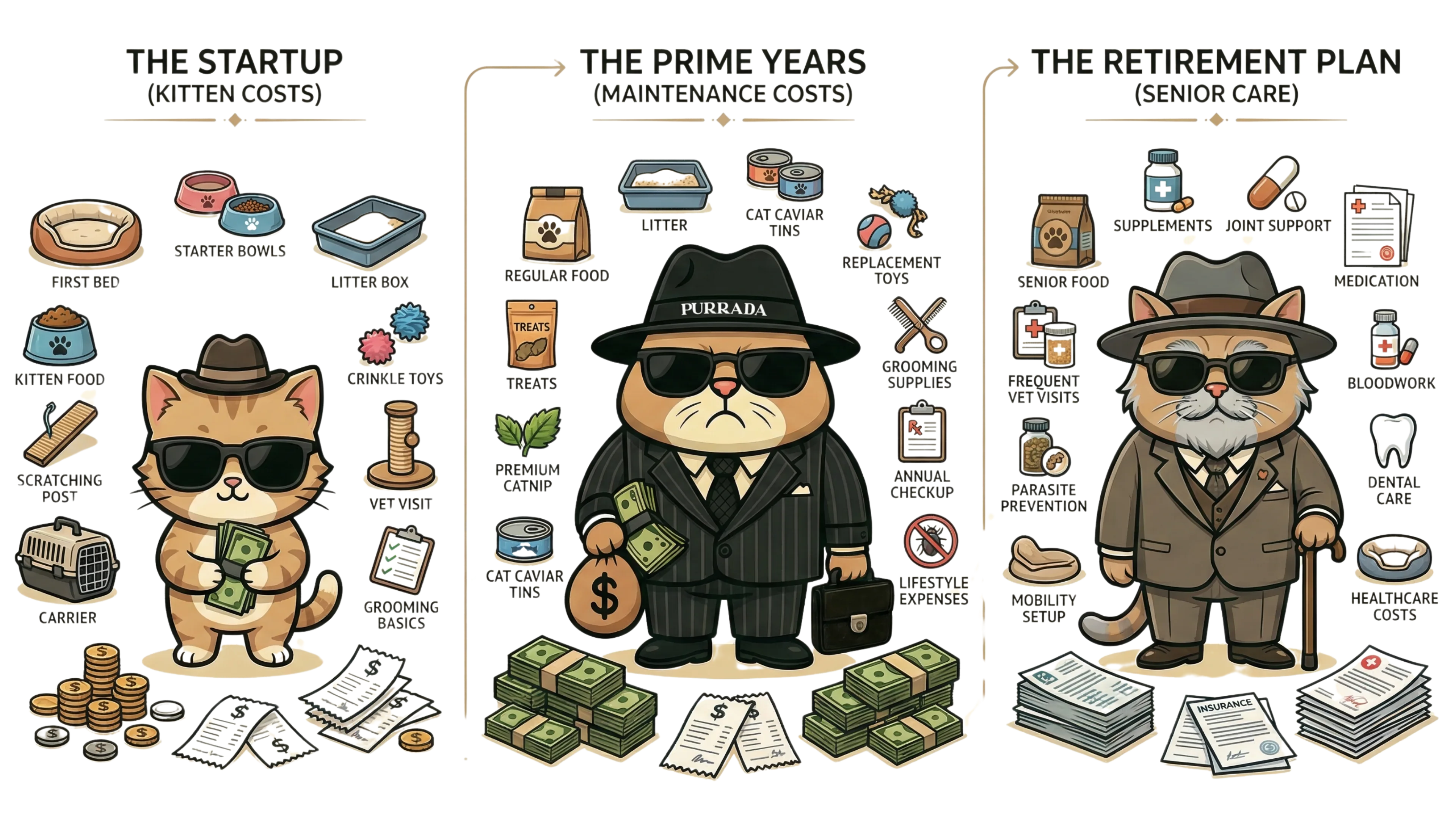
Kittens often carry the highest first-year burden because setup, vaccines, entry costs, and early procedures stack on top of recurring care. Adult cats usually show a steadier ownership pattern once the initial stage is over. Senior cats may shift the budget again because they often require more monitoring, more dental planning, and a more cautious health reserve.
Travel care can quietly become a major extra
Owners who travel often can see a meaningful jump in annual cost from pet sitting, home visits, or boarding. That category is easy to ignore when people think only about food and litter, but it can become one of the stronger extras for some households. Even a few trips per year can change the budget.
Multi-cat homes are not just “one cat times two”
Food, litter, routine health care, prevention, and insurance all scale strongly per cat. At the same time, some enrichment items, setup categories, and household accessories may be shared. That means multi-cat budgeting needs more structure. The total rises sharply, but not every category behaves in exactly the same way.
How to reduce cat costs without cutting care
- Measure real intake and recurring purchases.
- Check whether premium categories are truly worth their extra cost in your household.
- Compare insurance structure, not just premium price.
- Review litter value over time, not only per bag.
- Reduce waste in treats, toys, and replacement accessories.
- Plan annually, not only month to month.
Is cat ownership expensive?
It can be modest, moderate, or surprisingly high depending on food, insurance, veterinary care, travel-related care, country, and life stage. That is exactly why a structured calculator is more useful than a single average number.
What do owners underestimate most often?
Routine care, prevention, dental planning, travel care, and the difference between ordinary spending and safer budgeting are commonly underestimated.
What category usually matters most?
Food is often one of the biggest recurring categories, but insurance, city pricing, and travel-related care can move the total just as strongly in some households.

First-Year Cost, Annual Budget, Lifetime Cost, and FAQ
The most useful way to understand cat ownership cost is to stop looking for one magic number. A better approach is to separate the timeline. The first year of owning a cat is different from a normal year. An annual budget is different from a monthly snapshot. A lifetime estimate is different again because it looks forward from today and includes the length of care still ahead.
Why the first year usually costs more
The first year is often the most expensive phase because it combines recurring care with setup and entry costs. Even when the cat is healthy, the owner may still need a carrier, litter box, bowls, scratching surfaces, bedding, initial supplies, vaccines, microchipping, and sometimes spay or neuter costs. If the cat is purchased rather than adopted, the first-year total can rise further.
🍼 First-year cost
Recurring spend plus startup items and one-time medical or entry costs.
📅 Annual budget
The yearly ownership view with regular care and a safer reserve layer.
⏳ Lifetime estimate
A planning projection based on the years of care remaining from today forward.
Why annual budgeting is more useful than monthly-only thinking
Monthly cost matters, but annual planning often gives a more honest picture. Many cat expenses are not perfectly monthly in real life. Checkups, vaccines, prevention, dental planning, replacement accessories, and travel-related care may arrive unevenly. That is why an annual view often matches real ownership better than a simple month-to-month figure.
What a lifetime estimate really means
A lifetime cat cost estimate is not a prediction of one exact future bill. It is a planning projection that helps the owner see the longer financial shape of care. The estimate depends on the current life stage, the years of care remaining, and the ownership pattern selected in the calculator. A younger cat usually produces a longer projection. A senior cat often has fewer projected years remaining, but may also have a stronger care profile in the nearer term.
It is best treated as a long-range ownership planning tool, not as a promise of exact future expense.
What people often forget in long-range cat budgeting
- Food quality changes can move the total a lot over time.
- Insurance can be absent, basic, mid-level, or stronger, which changes recurring cost.
- Prevention and routine vet care often become more important with age and lifestyle risk.
- Senior cats may need more monitoring, more dental planning, and a stronger reserve.
- Multi-cat households can change the long-range total dramatically.
- Travel-related care can quietly add a meaningful amount over the years.
How to use this calculator more intelligently
Start with the profile that fits the cat best. Then compare scenarios. Then check the first-year, annual, and lifetime views separately instead of focusing only on the smallest-looking number. The strongest use of the calculator is not finding the cheapest possible interpretation. It is understanding how different ownership choices change the budget over time.
Cat Cost Calculator FAQ
How much does a cat cost per month?
That depends on country, food quality, litter, routine veterinary care, prevention, insurance, enrichment, travel-related care, and the number of cats in the household. A stronger calculator separates ordinary monthly spend from a safer budget target that includes reserve planning.
What is the first-year cost of owning a cat?
The first year often includes recurring monthly care plus one-time items such as adoption or breeder cost, carrier, litter box, setup supplies, vaccines, microchipping, and sometimes spay or neuter costs.
Do indoor cats cost less than outdoor cats?
Not always in every category. Indoor cats may use more litter and more home-based enrichment, while mixed or outdoor cats may require stronger prevention and a wider care buffer.
Why does the calculator show both monthly spend and monthly budget?
Because ordinary recurring spend and safer planning are not the same thing. Monthly spend is the narrower ownership view. Monthly budget adds reserve logic on top so the result is more realistic for people who want a stronger cushion.
How does the calculator handle more than one cat?
Food, litter, routine health care, prevention, and insurance rise strongly per cat, while some household items and accessories may be partly shared. That makes a structured multi-cat model more useful than a flat guess.
Can I replace the calculator’s defaults with my own costs?
Yes. That is one of the most useful parts of the calculator. The default model creates the structure, but custom food, litter, vet, insurance, travel care, and one-time entries make the result more personal and more relevant to your own household.
Is the lifetime estimate exact?
No. It is a planning estimate based on the selected ownership pattern and projected years of care remaining from today forward. Real future cost can change with life stage, local pricing, and care decisions.
Useful related tools
- Cat Weight Calculator — check body-weight planning and target direction.
- Cat Calorie Calculator — estimate a more practical feeding target.
- Cat Age Calculator — understand life stage and age-related changes.
- Cat Pregnancy Calculator — track timing and milestones for pregnant queens.
- Cat Name Generator — find names that fit your cat’s personality and style.
Shop Funny Designer Cat Bowls
Shop funny cat bowls, designer cat bowls, and stainless steel pet bowls made for cat lovers who want unique pet accessories with parody fashion style. Durable, easy to clean, and only at Mad Cat Cartel.


Vendor: Mad Cat Cartel
Type: Cat Bowl
Pawlenciaga Designer Cat Bowl Logo Stainless Steel Pet Bowl





Vendor: Mad Cat Cartel
Type: Cat Bowl
Hermèws Paris Designer Cat Bowl Stainless Steel Pet Bowl


Vendor: Mad Cat Cartel
Type: Cat Bowl
The Cat Face Designer Cat Bowl Stainless Steel Pet Bowl

Vendor: Mad Cat Cartel
Type: Cat Bowl
Louis Mewtton Logo Stainless Steel Designer Cat Bowl


Vendor: Mad Cat Cartel
Type: Cat Bowl
Off-Whisker Utility Feeder Designer Stainless Steel Cat Bowl


Vendor: Mad Cat Cartel
Type: Cat Bowl
